Each view of a URDAD model shows one concern, and each is drawn here as the
modelling tool draws it, from a small model of a shop. The terms link to the
glossary, and the
method says how the views are used: a
service, its requirements, who addresses each, and the process, repeated one
level down.
Scope View
|
-
Box with a tab: a responsibility domain, named on its tab.
-
Line from a ⊕: containment: the domains it is divided into.
|
Dependencies View
|
The domains whose services a domain’s processes request, and those services.
|
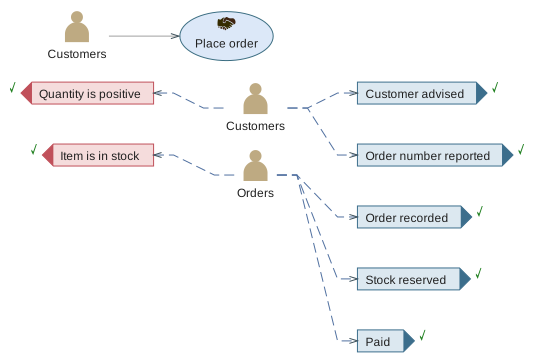
Functional Requirements View
|
-
Ellipse with a handshake: the service contract.
-
Figure: a stakeholder: a domain with an interest. Above
the contract, with a solid arrow to it, a domain the contract is published to,
which may request it.
-
Red flag pointing left: a pre-condition: what must hold
for the service to be provided. When it does not, the service refuses by
raising its exception.
-
Blue flag pointing right: a post-condition: what holds
once the service is provided.
-
Dashed line: the stakeholder who requires that condition.
|
Responsibility Allocation View
|
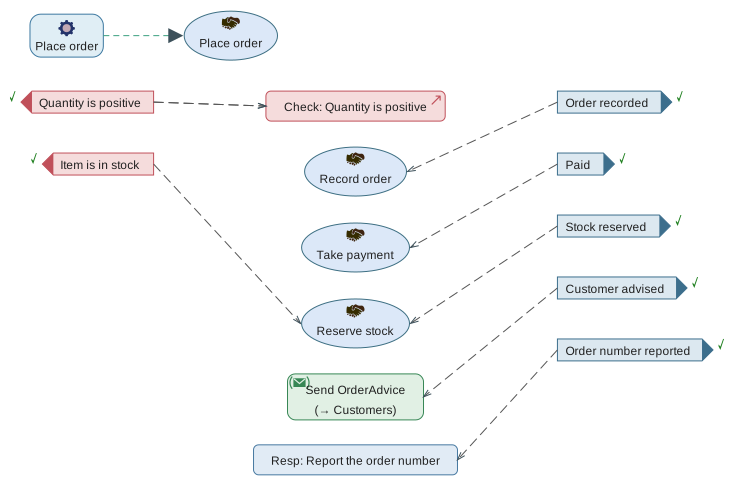
Who addresses each requirement.
-
Box with a gear: the process, realizing the contract
(dashed arrow with a closed head).
-
Dashed arrow: from a requirement to the step that addresses it: a request of
a lower-level service (an ellipse), a check, a message sent, or the
response.
|
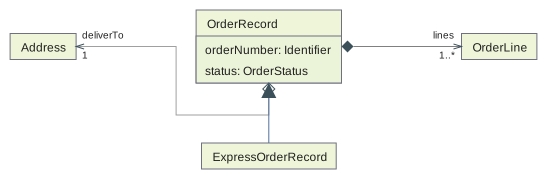
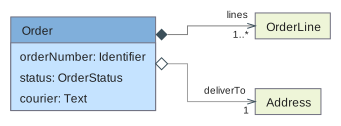
Data Structure View
|
-
Filled diamond: composition: the part belongs to the whole.
-
Open diamond: aggregation: the part is shared.
-
Open arrow alone: association: a reference.
-
Closed triangle: specialization: the structure below has every field of
the one it points to, and more.
-
Numbers: multiplicity: 1, 0..1, 1..,
|
Process View
|
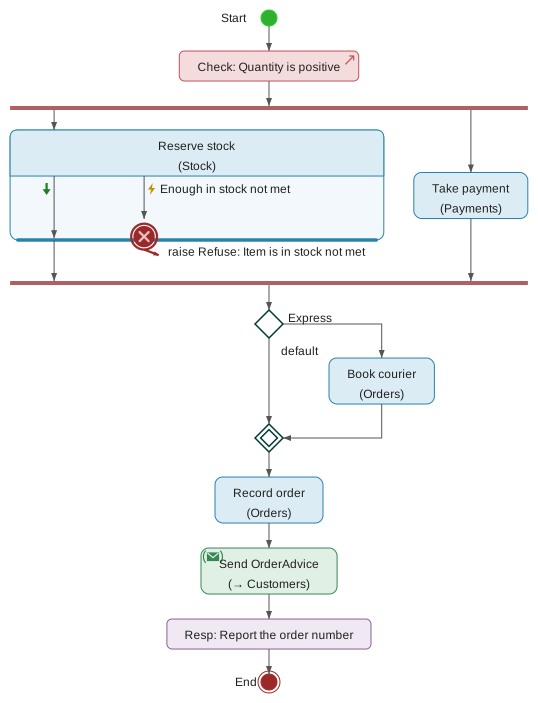
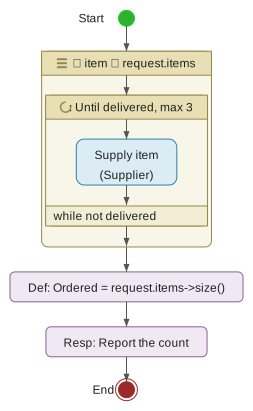
How the process orchestrates its steps, from start (green) to end (red ring).
-
Check (red box): tests a pre-condition, and refuses if it does not hold.
-
Blue box: a service request: the contract
requested, and the domain providing it in parentheses.
-
Green arrow ↓: the request’s success path.
-
Yellow bolt ⚡: an exception arm: the refusal named, and what is done about
it.
-
Red circle with ×: raise an exception: this service refuses.
-
Blue double diamond: where a request’s arms rejoin.
-
Two heavy bars: concurrent flows: every lane runs,
and all are joined.
-
Diamond: alternate flows: the first conditional flow,
in their order, whose condition holds is taken, else the default; the
double diamond rejoins them.
-
Green box with ✉: send a message, to the recipient after →.
-
Resp (purple box): populate the response.
|
Loops and variables
|
-
Frame headed ∀ x ∈ xs: for each: its body runs once per element of the
collection, one after another (≡) or all at once (|||).
-
Frame headed ↻: while: its body repeats while the condition in its footer
holds, at most as often as the header says.
-
Def (purple box): define a variable: name a value once, for the steps after it.
|
Entity View
|
An entity: a business object with an identity, with every
field its views hold.
|